

Residential solar and battery adoption is accelerating across Europe.
Your customers are investing in these systems – and looking to make the most of that investment. But too often, batteries sit idle behind-the-meter for much of a typical year.
It’s time to lead the charge; to transform your residential battery fleet into revenue-generating, cost-saving, customer-delighting assets. Here’s how:
- New revenue streams through smarter trading
- Cost/imbalance reduction that seriously scales
- Value-add that drives up prosumer retention
- Building a future-ready trading fleet
- A SaaS platform built by energy experts
Prosumer; friend or foe?
Historically, the prosumer goal has been one of greater self-sufficiency, typically mapped to a larger (or growing) household power consumption.
This risks placing some of an energy retailer’s most valuable customers in direct conflict with the retailer’s own objectives. Some retailers have even had to politely off-board prosumer customers – as the discrepancy between household forecasts and what’s actually happening behind the meter has ballooned to unsustainably unprofitable levels.
Ultimately, the mainstream prosumer is simply looking for a smart way to maximise the value of their investment, and minimize the final figure on their monthly bill.
The default is self-sufficiency only because alternative, trading-led value streams haven’t traditionally been accessible to them.
But batteries are much more than just solar storage. And these tradable assets don’t need to be sitting idle behind the meter for quite so many months.
New revenue streams through smarter trading.
Every onboarded battery becomes a trading asset. Scale this across thousands of households, and you’re looking at meaningful MWH capacities – and portfolio-level revenues.
1. Day-Ahead
Trading flexibility for aggregated fleets typically starts with day-ahead spot optimization. Podero provides secure, standards-compliant APIs and integration mechanisms. Utilities use these to share the market data that guides our AI models and optimization algorithms, alongside household preferences and environmental signals (weather etc.). Through the same integration, you’ll receive forecasted load curves, and monitor the execution of the traded plan.
2. Intraday
Batteries are perfect for intraday markets. Low latency means they can capitalize on price volatility within the trading day. With the right trading enablement, you get the forecasting accuracy, real-time control, and market integration needed to capture meaningful intraday value:
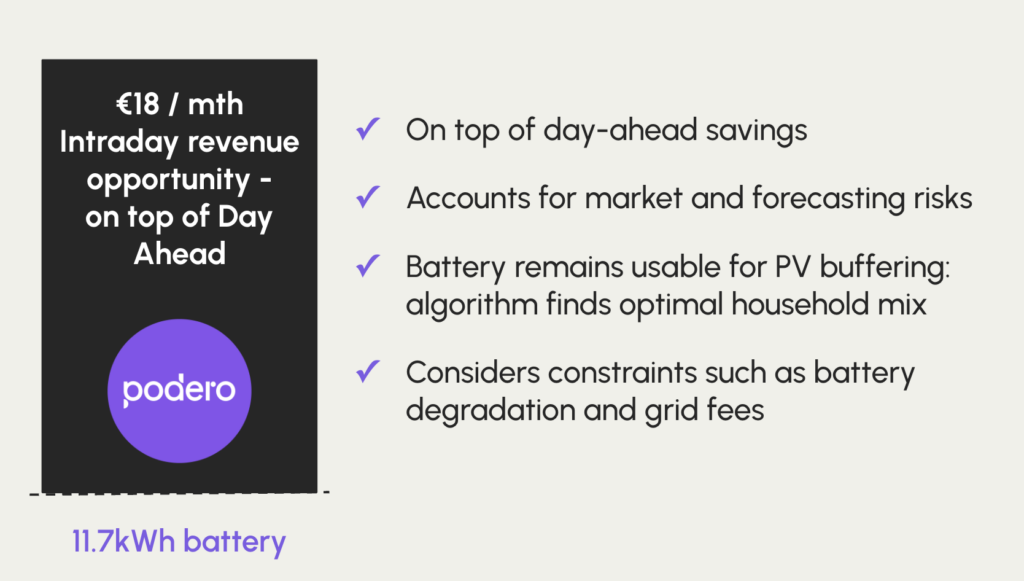
Podero modelled intraday revenues: €18/mth
Notably, these revenues stack on top of day-ahead optimized savings – AND the battery remains usable for household PV generation. Podero’s algorithm constantly seeks an optimal solution across both PV buffering and market opportunities. While always considering real household constraints such as grid fees or battery degradation.
3. Demand Response
Beyond immediate, household-by-household opportunities from intraday, there’s the longer-term play: building a highly responsive residential battery fleet that can participate across multiple trading marketplaces. Depending on your geography, this could mean balancing energy markets, capacity markets, or regional DR programs.
Cost/imbalance reduction that seriously scales.
1. Sharper forecasting, reduced imbalance
Your prosumer household risks becoming one of your most difficult – and costly – to forecast.
This is the hidden value in residential flex that many utilities underestimate. When you have visibility and control over what’s happening behind the meter – when batteries will charge/discharge, how PV generation will flow – your 24-hour forecasting accuracy improves dramatically.
Better forecasts mean lower imbalance costs. Fewer surprises. More predictable procurement. Over thousands of devices, this adds up fast.
“Improvements of even 1% in forecasting claims could translate to savings of circa €1.3 million per year for a typical mid-sized energy utility.”
European Commission Joint Research Centre, March 2025
2. Peak shaving
Pre-charge batteries in the off-peak, to discharge during peak mitigates peak power charges for your grid operations. In markets like Sweden, where peak costs are increasingly passed on to households, it’s also a direct end-consumer benefit.
The result? Lower network costs, happier customers, and a compelling value proposition for prosumers who care about grid efficiency.
3. Negative price curtailment
Many export tariffs are fixed, meaning that when prices go negative, household exporters still get paid – while their utility effectively pays twice. And negative pricing is rapidly becoming a regular occurrence across European markets.
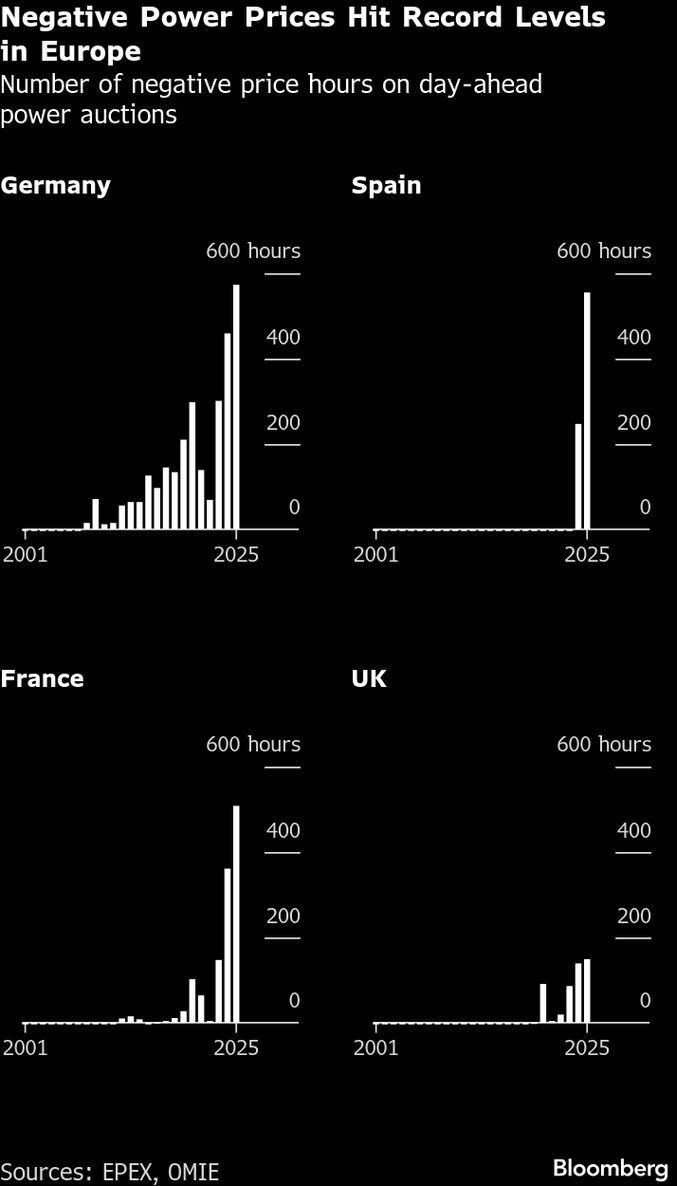
European day-ahead negative power pricing trends to end 2025.
Source: Bloomberg (EPEX, OMIE)
An industry first, Podero’s platform can schedule PV system curtailment according to day-ahead negative pricing. The solar still powers the house and battery, but export is paused. Whether to still compensate the consumer according to their export tariff contract becomes a retail consideration – not a technical inevitability.
Value-add that drives up prosumer retention.
A PV / battery system is a big household investment. Prosumers want to feel they’re maximising its ROI, as fast as possible. And with smart, market-linked prosumer propositions, their utility can add value beyond self-sufficiency on sunny days.
1. Optimized battery scheduling
Most residential batteries sit idle for much of the year, especially in winter. That’s wasted potential. With a residential flex proposition, batteries stay active year-round – automatically charging when prices are low, discharging – or even exporting – when prices are high. Contributing materially to household savings every single day.
And with trading enablement in place, even fixed contract prosumers receive a share of the optimization savings (see over).
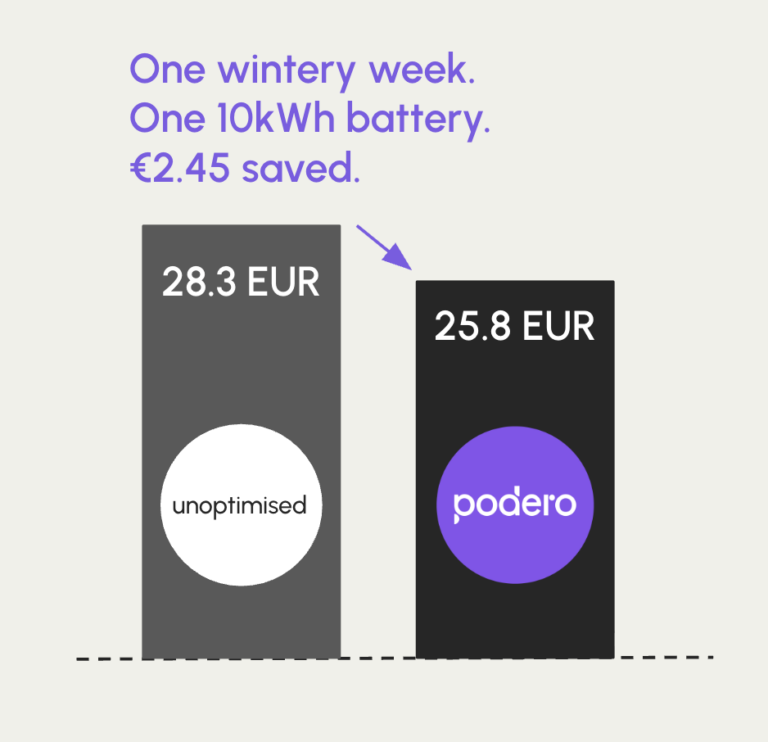
Podero day-ahead battery optimization, ~ 25.8 EUR 25.8 EUR €10/mth savings
When customers see their hardware investment paying off faster thanks to innovative products from their supplier, they stay. They recommend you to others and become advocates for your brand.
2. Brand halo, reduced acquisition costs
Beyond the numbers, there’s the feeling. Prosumers want to feel smarter, more self-sufficient, more in control of their energy. Automated optimization delivers that emotional upside alongside the financial gains.
We see this brand halo in action with Podero-enabled products in market. Not only impacting retention, but cost-efficiently attracting in net-new customers looking for a more ambitious energy partner.
Building a future-ready trading fleet.
This isn’t just about today’s revenues and savings. It’s about being ready for where the energy markets are heading, and locking in a scalable residential fleet.
“We're seeing the emergence of distribution level markets. And there are lots of platform providers, pilots and projects that are appearing around Europe to try and manage that congestion at the more local level.
The big batteries that are higher up the grid can't play in those markets. So it's a different game. Smaller batteries, domestic batteries, EVs, even flexibility from other assets can provide that local service in a way that the big batteries can't.
So we need to stop thinking about flexibility as this one big thing that happens at the top of the grid, and think about how you can optimize at different levels of the grid.”Jon Ferris, Head of Flexibility, LCP Delta, Feb 2026
1. Fixed AND dynamic
The mass-market PV/battery owner is different from the super energy-engaged early adopter. They’re normal, energy-aware households who made a sensible investment in solar to reduce their long-term grid consumption. As such, many prefer to stay on fixed tariffs; in 2025, 46% of customers in Norway actively switched into a new government discounted fixed tariff.
Right now, these fixed-tariff customers are missing out on the strategic value of their batteries. Meanwhile, many utilities assume flexibility is a dynamic tariff concept.
But trading enablement combined with billing integration means everyone benefits from battery flexibility, even on fixed contracts. You buy smarter on their behalf, optimizing their battery over a 24-hour cycle, and pass savings back to them – without requiring a tariff switch.
This opens up your addressable market significantly. You’re not just targeting the 5% of early adopters. You’re reaching the 30-40% of prosumers who want smarter energy but aren’t ready for full dynamic pricing.
2. Future-ready fleet management
As renewable penetration increases and grid volatility rises, flexible assets will become essential. The utilities that build – and can retain – responsive residential fleets now will have a significant strategic advantage in 5-10 years.
You’re not just launching a product.
You’re building transition-ready infrastructure.
A SaaS platform built by energy experts
All of this sounds great on paper. But can you actually deliver? Here are 4 reasons why, with Podero, we believe you can:
1. Unmatched device coverage
Podero is integrated with Europe’s largest PV OEMs. We have strong relationships with many more, and prioritize your preferred brands for new integrations in a specific market.
2. Technical superiority
Our trading solution orchestrates devices based on real-time market signals. Our forecasting is built for trading accuracy, not just consumption estimation. And our API integrations go deep – into your app, backend systems, trading platforms, ERP, and customer service tools.
3. Proven commercial products
E.ON Sweden runs Smart Heating on Podero. Austria’s Oekostrom launched a Podero bolt-on across their portfolio, for multiple device types. E.ON UK describes Podero as the “brains of the operation” for its Next Gen Home project, smart steeringPV/battery, EV and heat pumps.
4. Speed to market
Podero’s cloud-enabled API can start steering an inverter in under 10 minutes. That’s not hyperbole – it’s our white-label web app, ready for soft launch, with no complex hardware or integrations. We partner with you to test, learn, and prove your proposition quickly.
Ready to unlock your residential battery fleet?
The opportunity is clear. The technology is proven. The economics work.
Now it’s about execution.
Find out more how we made it work with E.ON Next gen Home.
Let’s talk about how Podero can help you activate prosumer flexibility, capture returns today and in the future – and deliver smarter products to delight your most energy-savvy customers. Making batteries work harder, for them and for you.