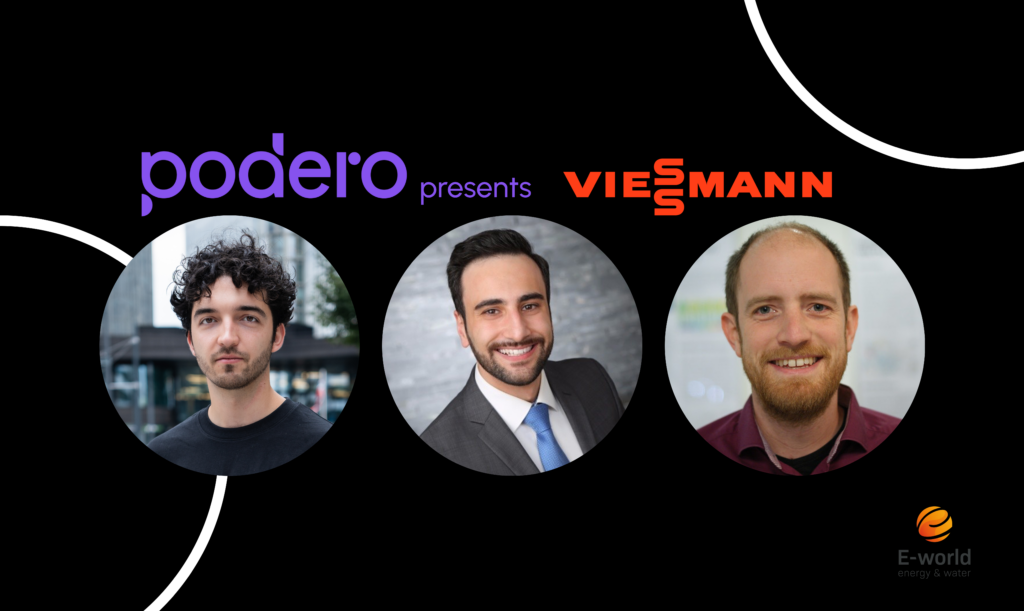
About the guests: Michael Hanna and Moritz Lauster are from leading manufacturer Viessmann Climate Solutions, a global provider of sustainable climate (heating, cooling, water and air quality) and renewable energy solutions. Michael is the Product Owner for the Developer Portal and Viessmann’s API Program. Moritz is Chief Engineer for Viessmann’s Energy Management Systems.
In this conversation, Louis Jabbour (Head of Partnerships, Podero), Michael Hanna and Dr. Moritz Lauster discuss the Viessmann/Podero partnership around heat pump flexibility, residential device flex, and smart home energy management. Viessmann, as a system provider and “intelligence backbone” of the connected home, has built an open developer portal and Cloud API that allows third parties like Podero to integrate and co-steer Viessmann devices. They cover how the partnership manages control sharing, technical safeguards, response speed – and how Viessmann’s energy management intelligence, including flexibility forecasts, can help optimize grid flexibility services.
Watch the highlights in this LinkedIn video.
Podero: Welcome and thank you for joining us. Maybe before we get into the partnership, you can introduce yourself and I would love to hear when you tell friends or families that you are working at Viessmann. What’s their first reaction?
Michael: Thanks for having us here. I’ve been working for Viessmann now for more than seven years. When I tell them, they say, hey, can you get me a new boiler or a new heat pump? Do you have some discounts on that? I unfortunately have to say no. But by now they all know what Viessmann is about, and they are happy to hear that I’m working for them.
Moritz: I’m on the technical R&D team at Viessmann. And that’s also what reflects when I talk to my family or friends; they often see me more as a technician. So I’m often asked about how a heat pump works or if it’s not working, if I can do something about it. But usually it’s beyond my capabilities.
Podero: So as you know, Podero enables utilities across Europe to access residential flexibility in the form of inverters and batteries, electric vehicles, but also a very important segment for us is heat pumps. When we got in touch with Viessmann, what were your reservations or motivations to work with third parties like us, when it comes to flexibility?
Michael: Our motivation was, especially when we talked about integration and partnership with Polero, that you were one of the first who really approached us and had interest in getting integrated, or integrating our systems into your solution. And at that time, we also were reaching out and rolling out our developer portal. So that was really great to see that we had sort of a great interest – great timing.
And when we look at the hesitation that comes sometimes, for us it’s really important that we ensure the comfort of the user. That the user has his comfort level at home, he knows his house is warm enough. Therefore, we always need to secure that. But together, in this partnership, we’re confident that we always have the consumer and his preferences as the priority, and first thing on our mind. We have the same goal.
Podero: Comfort is extremely important for us. And that’s also my next question. How do we, maybe in this partnership, ensure that the asset owner trusts both Viessmann, and also Podero, that handing over control to a flexibility platform like ours actually works? What technical safeguards do we have implemented on hardware and software level that help towards ensuring this safety and trust?
Michael: So I wouldn’t really say that it’s handing over the control, maybe more sharing the control across each other. So we still have, with the Cloud API, the interface that is used by Podero to connect or integrate the heat transfer to your system, which gives a nice constraint and framework for others, for third parties, to work with our systems in a secure way. So, of course, the hardware is not doing something not suspected or could break in any way. The API already gives a great framework for that.
And on the other hand, I think with anything you are working on, how you work with the assets or devices, or when we change something, we are in a great exchange within this partnership to make sure that among this joint steering of devices, we always get the best out of it. Therefore, having a close relationship with others who we share control is key for us.
Moritz: I would say it reflects nicely on the level of control that you get. So the customer expects from us, from Viessmann, that we make sure the device works as expected and it’s fulfilling the priority need, which is keeping the home in its comfort zone. And then secondly, there is the need to provide flexibility, which is for the homeowner an addition, and creates value – though comfort has to be kept.
And that also reflects on the level of control we can give to companies like Podero, because it basically means we need to ensure comfort is always kept, while giving you the right access and the right level of control, so that you can also fulfill your needs when it comes to flexibility. That’s what you mentioned with constraints and the framework. That’s what it’s all about. It’s about understanding what you can do with the device without breaking the device. We make sure we have certain guards in place, but furthermore, it’s more important to ensure that you have the right understanding of what you could do (and what you should do) with the device. It’s all about partnership from that perspective.
Podero: Strong domain knowledge is key to implementing an API correctly, while cloud APIs provide the right abstraction to balance device control with safety and warranty commitments.
Could you briefly explain how to become a Viessmann steering partner? It would be valuable for other utilities to understand how to connect to your ecosystem.
Michael: I mean, getting a connection or getting an integration of a Viessmann system is quite easy. It’s like self-service. That’s how we built it up.
So, for example, for end users who would like to also use the Cloud API, for their own third party applications or systems. You can join the developer portal and get an API key so that everything is in place in order to get a connection as a self-service. And also other third parties or commercial partners can already use this. Access in order to test out the API without us having to do anything from Viessmann’s side. Everything is already in place.
When it comes to the partnership, we want to know who really wants to commercially use the API or to steer many systems, not just one of their own. So the way to do this is of course approaching us, then we jointly come together and discuss use cases. We also have a lot of good things we do within our ecosystem, but where is the benefit for the user within this partnership? And from there, we can set up the agreement. The API still stays the same, the access stays the same.
Podero: You just mentioned the Viessmann ecosystem. I know Viessmann has invested a lot of time and effort into building an ecosystem where a customer is not necessarily limited to buying a Viessmann heat pump, but they can also equip themselves and their family with multiple Viessmann assets. As far as I know, they are all accessible via the cloud. Can you share more about how you intend this ecosystem to work and how third parties can engage with it?
Moritz: That was a strategic decision made years ago, that Viessmann sees itself as a system provider. So it’s not only about one heating device, or heating itself, it’s about energy in your home. And it also comes with a digital ecosystem. With touchpoints to end customers, and to partners, and additional services that offer additional value. So it’s the typical story of digitizing a certain part of the industry. Viessmann was always one of the first movers in that regard when it comes to the energy industry within the home. That also means we provide value propositions on the system level and also on a higher ecosystem level for all stakeholders.
Then, if you play that system game, you always have those two aspects. We have our own ecosystem and everything that is within our ecosystem we handle best. On the other hand, it’s a common use case that a customer doesn’t buy an entire Viessmann ecosystem out of the box. Usually, you have something from a third-party provider. And then we need to make sure we can integrate those devices. So, we have different levels and different standards we apply to be able to connect to all those devices that you have within the home. We want to provide value to stakeholders in all different dimensions.
Michael: It’s the same we see when we look at our utility partners. Some of them already have a provider for battery storage. And they use a solution like Podero to get all their assets sent to their customers, getting them connected. And of course, we also want to be part of that with the utility. So we also see great benefit in jointly providing solutions there as well.
Podero: Viessmann positions itself as the intelligence backbone of a comfortable green home. When you think about a third-party integration, what is your ideal way of being compatible with third-party steering? On the Podero side, we look at prices, we look at capacity of the home and then schedule a load. And this is the load we also use when marketing the flexibility of the device. However, what gets lost here is Viessmann intelligence that can be used to integrate other locally connected devices or even data points that are not accessible through the API that we just can’t include when steering. How can we bridge that gap?
Moritz: So definitely this intelligence is at the core of what we do. The system only provides additional value when you have that intelligence. And for sure we would like to make sure that this intelligence can also be applied when others send us any kind of control signals. We would like to provide you with all the information.
For me, the key here is when we talk about our own ecosystem, we have our own energy management system at the heart of our system. It’s not an extra box. It’s just whenever you get a Viessmann heat pump or battery system, then you have this intelligence, this energy management system in your home. Then it’s all about how we can expose this intelligence towards others. So it’s about cooperation, so that you can make use of the intelligence as well.
For example, we make a flexibility forecast for you; this is the flexibility band you can expect from this home. We take all the (household) decisions we are already aware of into account. We let you know there’s a certain self-consumption over this day, so do not expect the same amount of power drawn from the grid as you would have if there had been no PV. We take all this into account and deliver you a flexibility band. And then it’s also about updating those forecasts all the time. So there’s a lot of intelligence we can gain from each other because ultimately what we could offer is aggregating our homes as one flexibility pool that we claim we have best control over, because those are our devices… and we would hand over this flexibility to you, because we are pretty sure you can handle flexibility better and bring it to the market more effectively than us. Collaboration.
Michael: Exactly. It always starts with a kind of asset steering, purely controlling the operating parameters or other similar signals to single assets. But, as Moritz said, the intelligence we already provide, I like to see that we go with these integrations to a different level. And for us this also means that we build solutions or services that we know… but we also need to think of new services we build together with a partner. So we can provide the benefit to the consumer.
Podero: The key is the partnership and I think we have a very fruitful partnership here where we put our heads together on the problems – and also the progress we make on the ground on Viessmann heat pumps. Maybe going a bit away from the technical details, one of the questions we usually get asked by utilities is, if you send a signal to the heat pump, how fast does it act?
Michael: So whenever you send us a control command or something being changed on the system, the API immediately responds in milliseconds that this request has been accepted and sent to the device. It depends on the device itself when the change is actually being carried out. But usually, depending on which kind of steering it is, it can go within seconds. An example: if you would like to have hot water immediately, because you see there’s cheap electricity, I want to use it. You send us the signal: I want the hot water to now heat up. Then this is usually carried out immediately. Of course, there are constraints to the system, especially when we talk about the heat pump and the compressor, run times, etc. Local constraints… but usually this is carried out within seconds.
Podero: When users opt into a steering service from their local utility which uses the Podero platform on the backend, how can we build trust on the end user side to tell them, well, yes, your device is controlled, but your warranty is not at risk?
Michael: Simply what you can tell them is that, again, with the Cloud API, it’s basically the same interface we are using, like vCare, that we provide to our end customers directly. So we’re talking about the same interface, same data points, same control that you also have as an end user via vCare.
Podero: Maybe thinking a bit about the future, I think every heat pump owner should participate in flexibility. And right now, it takes the user to learn about the offer from their local utility, then to connect to ViCare with their credentials, then the device is connected. Maybe we can turn this around and there’s a future where Viessmann enrolls users automatically?
Michael: What we currently have is a situation where the user wants to connect his heat pump, he has to log in within the app of the third party and remember his login credentials for the VK app, not often already present. Like you log in once within vCare and then you forget about your credentials sometimes. So this is kind of a hurdle. What I can imagine is in the future, perhaps like in an app, something where you can confirm or allow access to third parties with one click for example. There’s nothing concrete now. We are currently really working on making this more seamless. But I think it absolutely makes sense.
Moritz: It’s of course about standard procedures, right? So data and also cybersecurity is of highest importance for us. So we apply all the methodologies and techniques that are out there. And it also reflects in how we allow authentication in the apps. So whenever there’s a good way, we are exploring this to make it easier for the customer without compromising on data or cybersecurity.
Podero: Thank you. Any final thoughts on the partnership between Podero and Viessmann?
Michael: I really enjoyed the partnership since it also brings new aspects for us, new things we are thinking about at Viessmann and also, let’s say, the successes, the savings you achieve. So a great feature for us to see what the steering can bring to the consumer. Going from this asset steering to another layer of integration, that’s really something I would love exploring and evaluating together with you guys from Podero.
Find out more about all our OEM partners and which devices Podero can steer.