

Ursula von der Leyen’s State of the Union 2026 put a number on Europe’s grid problem. More than 80 GW of renewable capacity was installed last year. Six times more is still queued for a connection. Her solution to the gap was the grids package: build, build, build. Invest faster, speed up connections, develop storage.
All correct. All painfully slow. A transmission line takes ten to fifteen years to build. The Commission’s own estimate puts European grid investment needs at €584 billion by 2030. That leaves four years for execution. For some, this timeframe is barely enough for a procurement process, let alone building the metal purchased. A shortage of transformers and cables further complicates the picture. The flexibility gap is real.
Of course, infrastructure development is still needed. But the European energy system needs a software update just as badly as more transmission capacity. The flexibility layer offers an instant solution, unleashing somewhere between 100 and 200 GW of controllable flexible demand across EVs, heat pumps, home batteries, smart appliances and commercial loads.
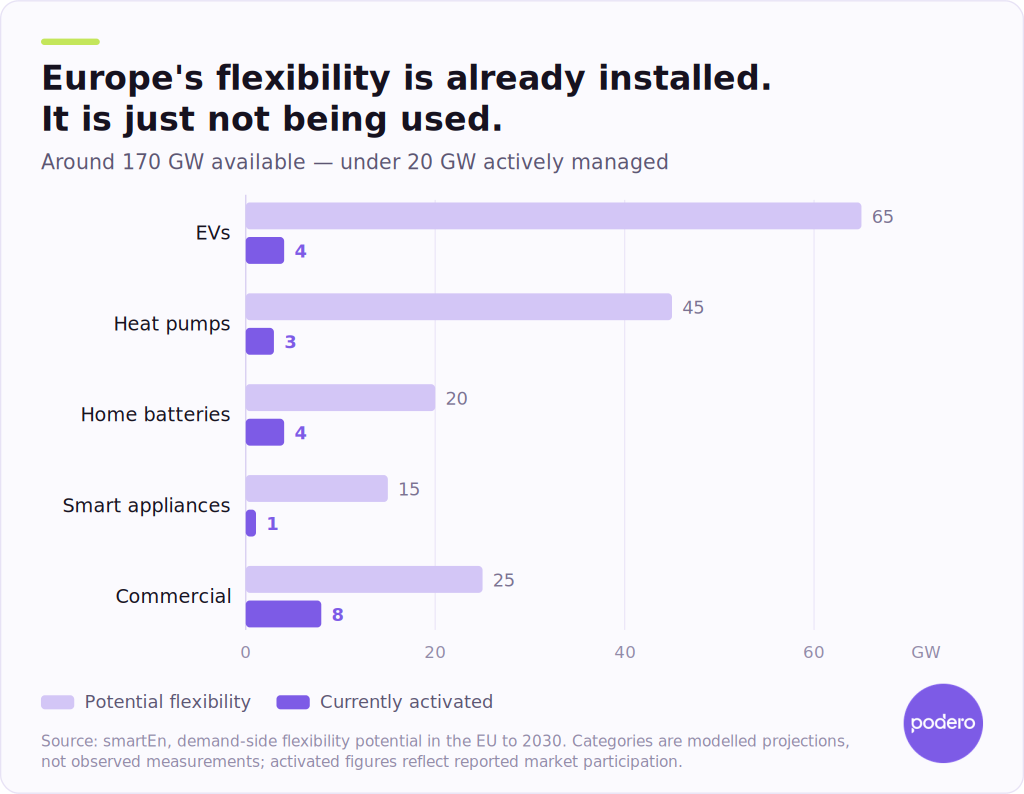
Right now, under 20 GW of it is actively managed. More than a hundred large power stations’ worth of capacity, already installed, already paid for, already plugged in, and never asked to do anything. And this is not ordinary energy either, this is peaking capacity, not baseload. The flexibility layer does the job a gas turbine does when the system is tight. And there is more of it sitting idle in European homes than Germany’s entire peak demand.
So why isn’t it being used? Three reasons, and none of them is hardware.
You cannot trade what you cannot see
A heat pump that reports nothing is not a flexible asset. Half-hourly or sub-hourly visibility into what a device is actually doing, at the moment it’s doing it, is the precondition for everything downstream, and across much of Europe that data either doesn’t exist, arrives too late, or arrives in a format nobody can settle against.
ENTSO-E’s own recommendation starts in exactly this place: deploy smart, granular metering to make assets observable. Observability is not a reporting nicety. It is the difference between a portfolio and a guess.
Every device speaks a different language
Sounds like a minor detail, until you try to orchestrate different devices. A utility with 50,000 customers does not have one flexible fleet. It has eleven manufacturer clouds, each with its own authentication, rate limits, latency and definition of what “charging” means.
ENTSO-E again names it directly: unified control interfaces and standardised data exchange between operators, balance responsible parties and system operators. That standard does not exist yet. Until it does, someone has to absorb the fragmentation, and it is not going to be the household.
Nothing rewards it yet
Markets have moved faster than participation. Since October 2025, European day-ahead and intraday markets have settled in 15-minute intervals, because the system now changes faster than an hourly block can capture. The price signals are there. What is largely missing is a framework that pays households for responding to them, and a product that makes responding automatic, so nobody has to keep an eye on prices.
Regulation has a similar problem. Europe’s rules still reward building more grid more reliably than they reward running the existing grid better. Money spent on new hardware earns network operators a return, while money spent on the digital and operational tools that could free up capacity already in place is treated as a cost to be kept down. Regulators even have a name for it: CAPEX bias, CAPEX being short for capital expenditure. Two of Europe’s key regulatory bodies have flagged it as a barrier to smart grid solutions: ACER, the EU agency that coordinates national energy regulators, and CEER, the association those regulators run among themselves.
The grid’s CAPEX bias
The bias comes down to how network operators get paid. When an operator builds something physical, say a new transformer, that spending is added to its regulated asset base, and the operator earns a return on it for decades. Day-to-day operational spending works the other way: it sits under efficiency caps, and every euro has to be justified. So picture the choice. Put a transformer in the ground, and you own an asset you get paid for year after year. Buy the software that would postpone that transformer by a decade, or let you run the one you already have 40% harder, and you have added a cost your regulator wants you to cut. Faced with that, a rational operator builds, and the digital upgrade waits.
What makes this notable is who is saying it. ACER and CEER are not an industry lobby. They are the people who set the rules, pointing out a flaw in those same rules. ACER’s 2026 review of distribution investment finds the bias still present in several member states and calls removing it vital. CEER’s own paper goes further and names the consequence: frameworks that favour capital spending hold back efficient smart grid solutions.
The fix is known. Under a TOTEX (total expenditure) approach, capital and operational spending go into one pot, so an operator has no financial reason to prefer digging a trench over deploying software, and can pick whichever actually solves the problem. Italy’s regulator has been unwinding the bias this way for years. This is not a technical puzzle. It is a choice about what gets counted.
The grid problem has a retail answer
CAPEX bias binds network operators, but it doesn’t bind retailers. A supplier has no regulated asset base, so nothing it spends earns a guaranteed return over thirty years and nothing it buys has to be a physical asset to count. Where a DSO must justify every euro of operating cost to its regulator, a retailer can simply decide that steering its customers’ devices is worth more than leaving them alone. And then do it this quarter, rather than this decade.
That is the opening Podero was built for. We connect heat pumps, EVs, batteries and inverters through their manufacturers’ own cloud APIs, aggregate them into a portfolio a trading desk can dispatch against, and settle the value back to the household. No new hardware in anyone’s home, and nothing dug up in the street.
But being unblocked is not the same as being encouraged. A retailer that steers a fleet of devices can relieve a constraint the network would otherwise have spent capital on, and there is still no reliable way to be paid for that. Local flexibility markets exist: GOPACS in the Netherlands, NODES in the Nordics, Piclo in Britain. But most remain pilots rather than standing markets, partly because DSOs have little incentive to buy flexibility when building earns them more. The EU’s Network Code on Demand Response is meant to harmonise this by 2027. Whether it changes anything depends on how seriously member states implement it, which is where every previous flexibility rule has quietly stalled.
Australia is closing the flexibility gap: end-to-end dynamic network pricing
Australia is further ahead on the pricing side than Europe. Ausgrid’s Project Edith prices network use in five-minute increments that reflect the actual conditions at a particular time and place, replacing the flat “postage stamp” tariff averaged across a whole region. When the network is constrained, prices turn negative and a customer who imports or exports to help gets paid for it. The detail that matters most for Europe is the delivery route: the tariff is opt-in and reaches households through their retailer. Congestion becomes a price the supplier can steer against, rather than a problem only the network operator can see. The trial is at stage three of five, with a full listed tariff still ahead of it, but it is the clearest demonstration anywhere that grid constraints can carry a price tag a retailer can act on.
Three things would make the difference, and none of them needs new technology:
- tariffs that actually pass the signal through, whether dynamic or flex-for-fixed, where a household keeps its fixed rate while its devices are optimised against spot prices and the value comes back as a cashback on the bill
- full smart meter coverage across the whole of Europe
- aggregators able to bid demand into markets on the same footing as generation
The last one is already required by EU law. Most countries simply haven’t built it.
Which leaves an odd asymmetry. The part of the system that is paid to build cannot move for a decade. The part that could move tomorrow has no rate base to protect, and, so far, little reason beyond its own margin.
What the grids package is missing
The grids package asks how much Europe should build, but fails to ask what we can do right here, right now, with what we have. Those are different questions, and only one of them has an answer that arrives before 2030.
A flexibility activation target would close that gap. Not instead of the wires, because Europe needs those as well, and the queue von der Leyen described won’t clear without them, but alongside the metal, because activation is the only item on the list that moves in four years rather than fourteen.
And it gets easier from here, not harder. Doubling electrification by 2040 doesn’t only add demand to a constrained grid. It adds the largest flexible resource Europe has ever had, one heat pump and one car at a time. The devices are already here. Let’s use them.