

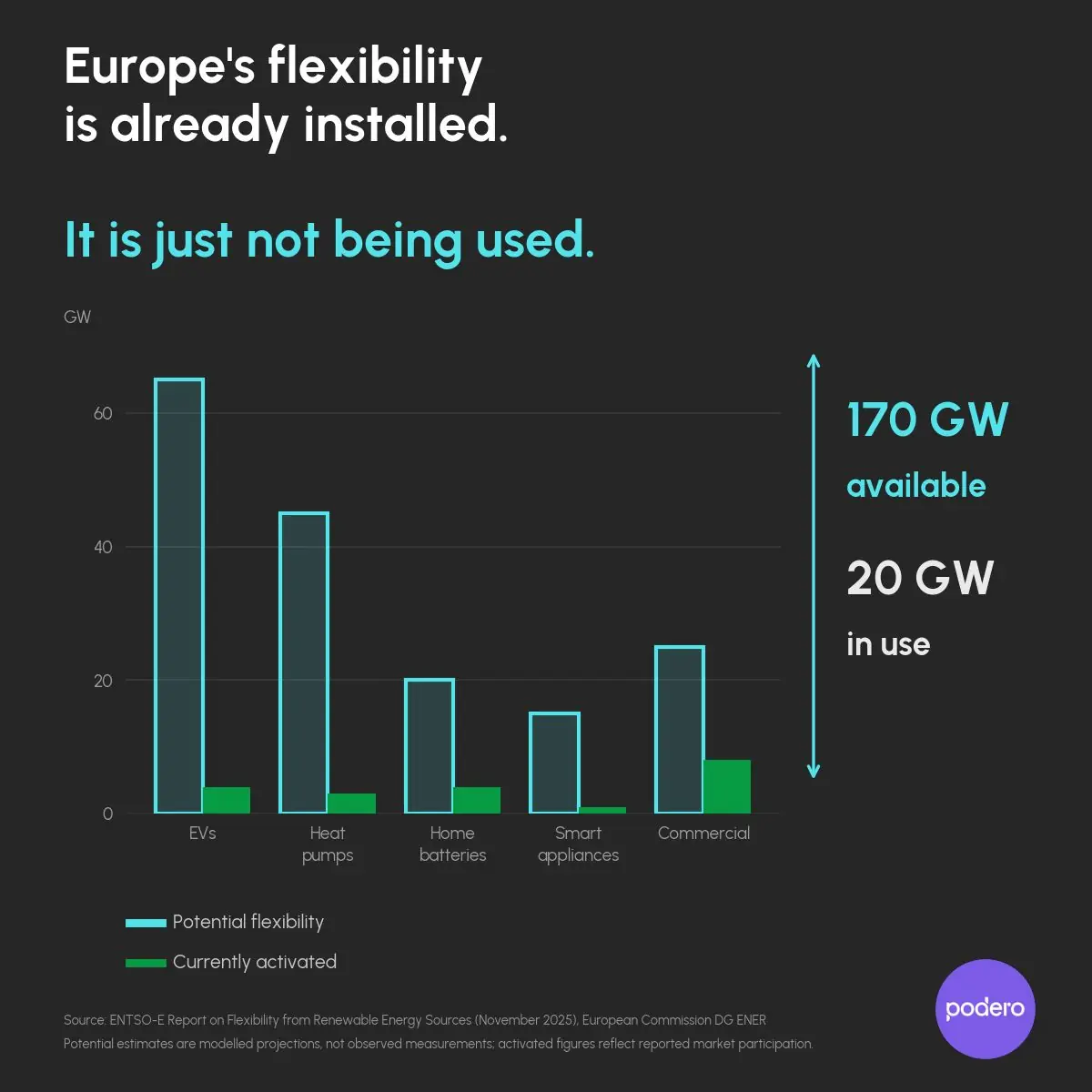
Germany has around 2.7 million stationary battery storage systems sitting next to more than six million solar installations, and another 286,000 storage units were registered in the first half of 2026 alone, a record pace. Home systems account for most of that count and hold close to 23 GWh of storage. Across Europe, installed battery capacity passed 100 GWh last year. Almost none of that residential capacity is traded, steered against prices or offered to the grid. It charges at noon, discharges in the evening, and sits still the rest of the time. The pattern holds across every flexible device class, not only batteries: ENTSO-E puts Europe’s controllable demand at 100 to 200 GW, and less than 20 GW of it is actively managed. Residential solar and battery flexibility has huge potential, but so far, the capacity has not been unlocked.
Meanwhile, residential electricity bills have outpaced inflation in 80 percent of OECD countries since 2010, and grid investment has been growing at about 8 percent a year since 2020, up from about 3 percent in the previous five years, with the cost flowing to customers through grid fees. BCG’s prescription for utilities is to use storage, demand response and flexible pricing to reduce peaks before building more capacity. The storage is already in people’s basements. The question is why so little of it is being used that way.
The reasons are well known, and most of them are not technical.
Residential flexibility is harder than large-scale flexibility, and more scalable
The difference between a utility-scale battery and a fleet of home batteries is fragmentation and behaviour. Instead of one asset under full control, you are orchestrating thousands of households with different hardware, different consumption patterns and different reasons for buying the system in the first place.
That same fragmentation is the argument for doing it anyway. Residential assets are the most scalable flexibility lever at distribution grid level, simply because of how many are arriving. BVES expects around 535,000 home storage systems to be sold in Germany in 2026, and the first half of the year ran ahead of 2025, helped by households pulling purchases forward before subsidies for new systems are largely cut from 2027. We have written before about how much of Europe’s flexibility is already installed but not used: home batteries alone carry an estimated 20 GW of potential, of which around 4 GW is actively managed.
There is a second reason that has nothing to do with megawatts. Residential flexibility lets a utility talk to the household directly. People who have put solar on the roof and a battery in the basement tend to want to take part in the energy transition, and a flexibility product gives them a way to do that which also pays. Prosumers are more price sensitive than the average customer, so the commercial motivation and the “doing something useful” motivation point the same way.
What actually blocks residential solar and battery flexibility
Four blockers come up again and again. Two are technical and two are human, and the human ones are the harder pair.
The first technical blocker is metering. By June 2026, 26.1 percent of Germany’s mandatory installation cases had an intelligent metering system, and 5.9 percent of all metering points, with 77 grid operators still at zero. The second is interoperability. Every inverter, battery, EV charger and heat pump speaks its manufacturer’s dialect, and the market is fragmented across hardware vendors and IT systems. This is why the depth of a platform’s OEM integrations decides more about a flexibility product than most tariff design choices do.
The first human blocker is organisational. Municipal utilities were built over decades around the commodity business. Flexibility asks them to change that structure, and changing an established structure is harder than starting a new one. That is why new players grow fast while traditional utilities struggle to keep pace. A May 2026 ZfK analysis of Germany’s roughly 900 Stadtwerke found that most large ones are at least piloting home energy management, while smaller and mid-sized utilities lag in staffing, technical know-how and strategic priority. An informal poll of about 40 utilities at an industry event found that most are still somewhere between orientation, pilot projects and choosing partners. A Trianel and Arthur D. Little study tells the same story from the other side: 80 percent of surveyed German suppliers see flexibility as untapped economic potential, but 40 percent are still only analysing the market and have not run a single pilot.
The second human blocker sits with the end customer, and it comes in two layers. The outer layer is awareness. A Forsa survey for the German consumer federation found that around 19 million German households, about 53 percent, were unfamiliar with dynamic tariffs, and 81 percent of those felt badly informed. Across Europe, 61 percent of consumers are unaware of their supplier’s offers for new products and services. The inner layer is control. Every household setup is different, and a VPP only works if every household in it can actually be dispatched. Connectivity failures and misunderstood device configurations are a constant source of lost flexibility, and a household that does not understand why its battery is being controlled will eventually switch the control off. That is a trust problem dressed up as an engineering one, and we come back to it below.
What the utility actually earns
Before the harder questions of who gets what and how to package it, it helps to know the size of the pot. The numbers below are ours, drawn from live fleets and our German market study.
Price-led optimisation of a home battery, meaning charging and discharging against day-ahead and intraday prices instead of blindly absorbing rooftop solar, adds up to about €136 to 140 per device per year compared with a price-blind battery, with roughly 70% of that realised across a whole fleet once forecasting errors and offline devices are counted. Discharging to the grid in expensive hours adds about €78 per year on top, after the MiSpeL cap. On fixed-tariff systems, simply not feeding in during negative-price quarter hours is worth around €25 a year, because those hours pay nothing anyway. We published the working behind these figures in our analysis of Germany’s 2026 solar record. Across a multi-device household with an EV and a heat pump, the total we see in live fleets is more than €400 per year, which is why we currently back it with a €200 per household per year savings guarantee: €120 a year for an inverter with battery, €50 for a heat pump and €1 per full EV charge, and Podero covers any shortfall.
Most of that money is not the utility’s own margin. It comes from the wholesale market and, in Germany, from the EEG account. The utility decides how much to pass on as cash back or a lower kilowatt-hour price, and how much to keep.
The second return is easier to miss and, in our experience, larger. In our live projects, customers who connect their devices are 21 percent more likely to stay on their tariff, and customer acquisition cost for the new flexibility tariffs is 19 percent lower, because customers read them as a new kind of product rather than a price comparison. At oekostrom AG, the smartSparen launch had a strong positive effect on customer retention alongside a brand acquisition “halo” and a launch that ranked as the second largest in company history. Device flex products are simply stickier. Consultants who advise German municipal utilities often use a rule of thumb: 3,000 prosumers are worth more to a utility than 10,000 standard-tariff customers. We think that ratio is the real business case, and the trading revenue is what pays for it.
Who should capture the value
Today, orchestration platforms and aggregators capture most of the flexibility margin, because the market is new and they hold the capability. That will shift toward the end customer as offers improve and competition increases. But the customer has to get enough to make onboarding worthwhile, otherwise the product does not scale, and the utility has to understand its own place in the value chain before it can partner with an aggregator at all.
The split should follow risk. A household that connects a device gives up very little and carries almost no downside, so it should be compensated fairly, but not at the level of the party that carries the risk. A utility with a growing balancing energy problem has real exposure if it does not manage its open positions, and its share should reflect that. Device manufacturers also need a share, otherwise there is no reason for them to maintain APIs. Nobody needs to construct the split; if any party in the chain prices itself too high, the market removes it.
The customer must get something, and must be able to see where it comes from. Households cannot access these markets on their own, so the enabler earns its share, but any opacity about why a battery charged or an EV waited creates mistrust, and mistrust turns into switched-off steering.
In our own product, that means the household gets a guaranteed floor, not a share of an upside it cannot see or verify, which is why we put a fixed euro amount per device behind the guarantee rather than a percentage. The utility keeps the upside above the floor because it carries the imbalance risk and owns the customer relationship. Platforms and manufacturers are paid out of the utility’s margin, not the household’s. And the floor only works if the household can see it being met, so a per-device savings report against a validated baseline is part of the product, not an optional extra.
What the customer-facing product has to look like
Product design is where the lessons are clearest, and they run against the industry’s own instincts.
Households do not want to change their behaviour. Their capacity to shift consumption around tomorrow’s price curve is limited, because lifestyles are fixed. A pure dynamic tariff asks the household to carry that burden. The alternative that has worked is a discounted fixed tariff in exchange for device control, what we call Flex for Fixed: the provider absorbs the price risk, the household keeps its routine, and the algorithm does the shifting. The Eurelectric survey is consistent with this: 78 percent of European consumers rank predictable bills among their top priorities, time-of-use offers are the most popular form of flexible contract, and critical peak pricing is the least.
The economics of owning solar are also shifting under the prosumer’s feet. Net metering, which credits exported solar at the full retail rate, is being wound down because it pushes grid costs onto non-solar households; Belgium and the Netherlands have already moved away from it, and Germany’s draft EEG 2027 would end fixed feed-in tariffs for new systems. As export value falls, the household’s battery and its willingness to be steered become the main way the system keeps paying for itself, which is exactly the value a utility can package.
The battery is not the only asset in the house that can soak up midday solar, either. A product built around the battery alone leaves the EV and the heat pump, the two largest flexible loads in the house, outside the optimisation, which is why we treat the connected home rather than any single device as the asset.
Fixed tariffs matter for a second reason. Only 7 percent of household customers monitored by ACER across the EU and Norway were on a dynamic price contract in 2025, and in nine countries more than 80 percent of consumers sit on fixed-term, fixed-price contracts. A flexibility product that only reaches dynamic-tariff customers leaves the bulk of the installed batteries untouched. That is why oekostrom rolled its smartSparen product out across every tariff, fixed and spot, with fixed-tariff customers receiving rebates on their monthly bills from the trading gains.
On transparency, two schools of thought exist among utilities running live products. One shows the customer exactly what they earned on a given day. The other says: here is your discount, it is more than you had before, let us handle the optimisation in the background. Most customers are closer to the second camp. They want their comfort unchanged and a number they understand. Only a small technical minority wants to see the dispatch logic. The detail should exist, available on request, but the first screen should be simple. The gridX survey of 300 solar, battery and EV owners in Germany, the UK and the Netherlands found 74 percent name financial compensation as the main reason to join a flexibility programme, while 37 percent worry about giving up control of their devices and more than half want a credible, reputable provider.
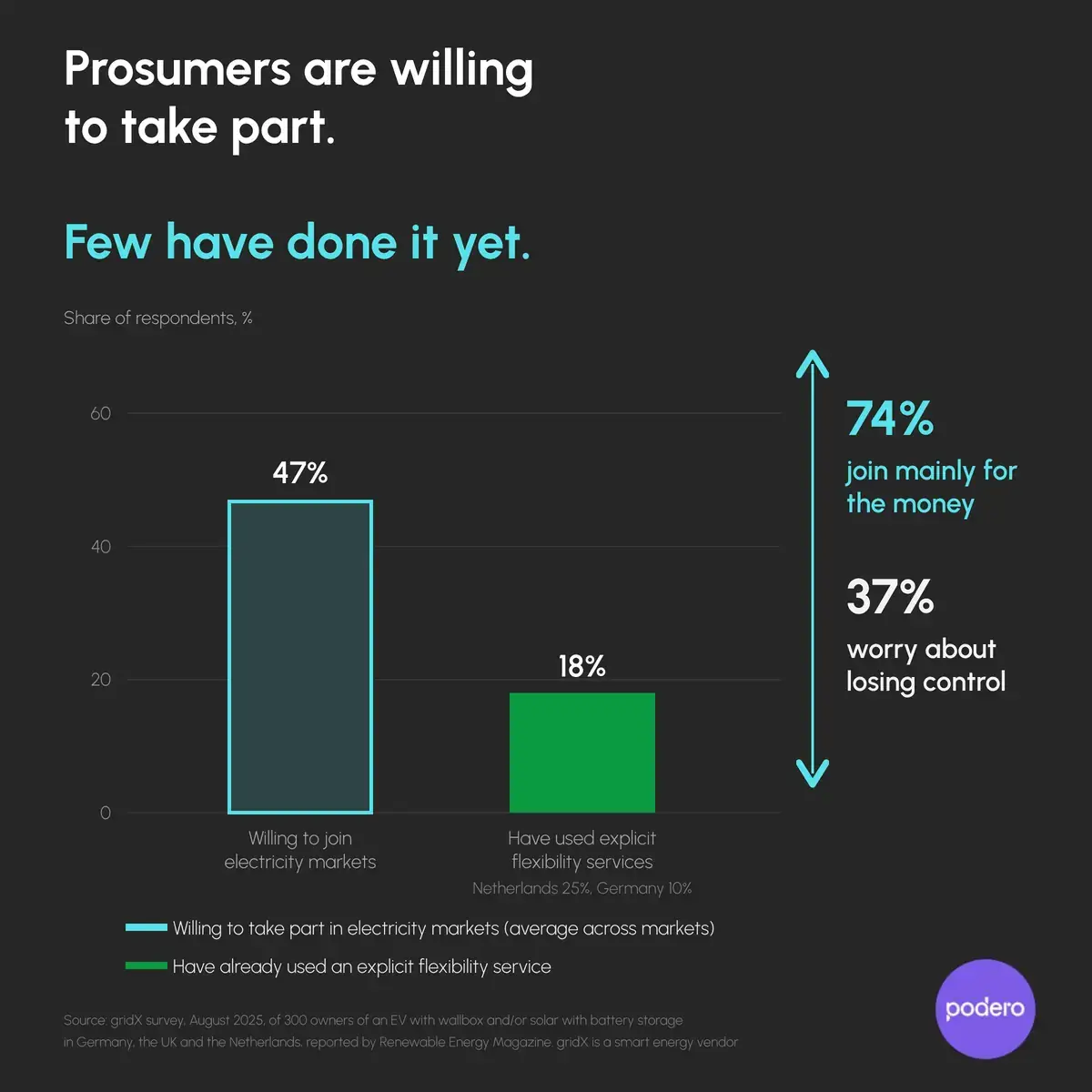
The design target is a sweet spot: enough information that the household knows why the battery is charging, not so much that it becomes confusing.
Traditional utilities also have a messaging problem. New entrants sell transparency, comfort and a feeling; they emotionalise the product. Municipal utilities tend to sell the hardware, a wallbox or a battery, and stop there. Combining the device with a story about what it does for the household is still missing in much of the traditional utility world.
Regulation: what would help, and what keeps changing
Regulation is not the first blocker, and the wish list is practical rather than sweeping: lower market entry barriers for small flexible assets, smaller minimum bid sizes, lighter prequalification requirements, and metering concepts that fit behind-the-meter devices.
Each of those has a concrete meaning for a home battery. A minimum bid of 1 MW means pooling a few hundred residential batteries before you are allowed into a market at all, which rules out every utility starting with a pilot. Prequalification rules written for gas turbines ask a fleet of 5 kW inverters to prove ramp rates and availability in ways that make no sense for devices that go offline when the household’s Wi-Fi does. And metering concepts built around a single meter at the grid connection cannot distinguish a steered battery from a household that simply used less. The smartEn Market Monitor confirms the pattern: in most of Europe, access to wholesale markets still requires the balance responsible party’s agreement, which shuts out smaller providers, and Great Britain and France are the only two markets where residential assets can join wholesale markets without it.
There is a cost-recovery angle too. BCG notes that batteries, smart charging and demand response are the obvious tools for relieving peak pressure, but that utilities often cannot recover the cost of deploying them under current rules, and that time-varying residential pricing still needs regulatory approval in many jurisdictions. The hardware is cheap relative to grid reinforcement; the rules for paying for it are missing.
The reverse risk is regulation that is announced, then changed, then takes years to implement. Sweden is the current example. In 2022 the regulator required every grid company to introduce capacity-based tariffs by January 2027; in March 2026 the government stopped the requirement and sent the regulator back to design a new model by 2027. Product teams that built around the old rule now have to wait.
Independent flexibility aggregators, now permitted in several markets, are a real threat to traditional utilities that move slowly. If an aggregator can sign a utility’s prosumers directly, the utility loses the customer interface and the flexibility revenue in one go.
Where the flexibility market is heading
Germany is a special case, and not a flattering one. Most municipal utilities there are still working on the first step, which is an energy management system for their prosumers, and many spent a year and a half debating whether flexibility would scale at all, or whether they should leave it to the new entrants and focus on commodity customers. That debate is now mostly settled: the prosumer is also the commodity customer, and losing one means losing the other. The practical conclusion is that utilities have to own the customer’s assets today in order to be able to trade their flexibility tomorrow.
Other markets are further along. Norway and Finland have over 90 percent uptake of day-ahead dynamic tariffs, and the UK has Europe’s largest range of tariffs and standardised flexibility procurement across all six distribution operators, which eases access for small residential assets.
New entrants are the other accelerators. When a company like Octopus enters a market, incumbents suddenly have a reason to move, because they can see customers switching to the new product. Octopus Germany went from about 300,000 to more than 500,000 customers in under a year and set itself a target of one million for 2026. Whether every such proposition delivers what it promises is a separate question, and one the whole industry has a stake in.
What a utility should do right now
For a utility deciding what to do, the answer is to start now, and not to start alone.
Every battery, inverter and charger installed today is the flexibility a utility will trade in three years. If those assets go in without good telemetry, reliable connectivity and a controllable interface, they will not be usable later, and the utility that lost the installation to a national solar company has also lost the flexibility. Nobody has to build the trading, forecasting and device layer themselves; the first job for a municipal utility is to look at the market, work out what it needs and start partnering. The hardest part is the decision to begin. Many utilities find the topic overwhelming and conclude that doing nothing is safer. It is not; it is only quieter.
If you want to see what residential solar and battery flexibility is worth for your own fleet, the revenue calculator gives a first estimate, and the oekostrom and E.ON Next Gen Home case studies show two very different ways to package it.